
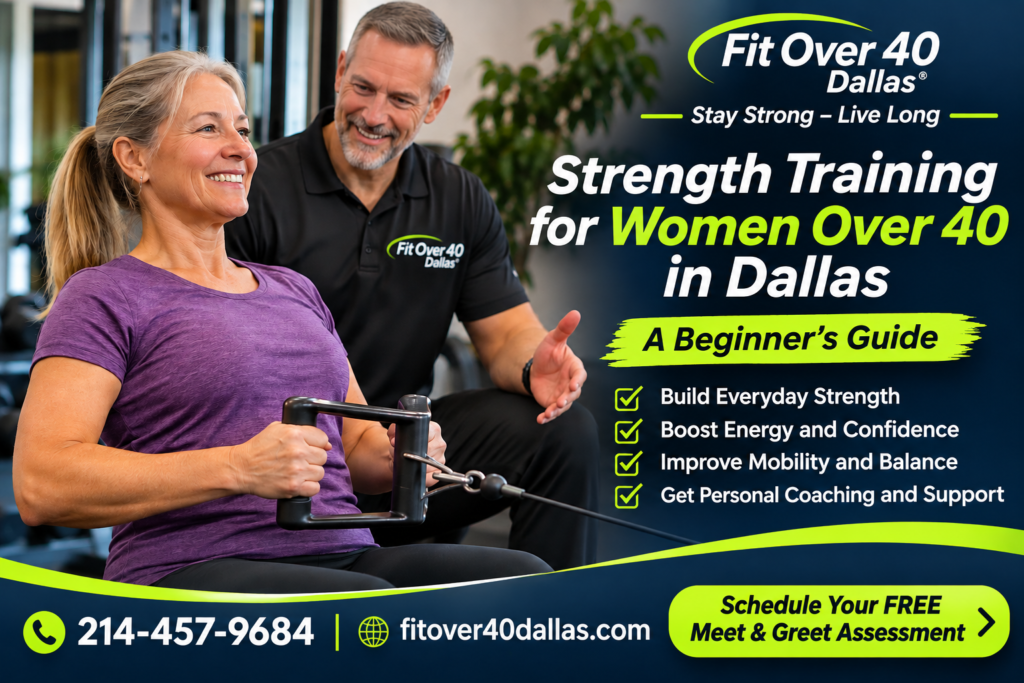
Strength Training for Women Over 50 in Dallas: A Beginner’s Guide
You may have spent years taking care of everyone else. Work, children, family, and a full calendar can push your own fitness to the bottom of the list.
Now you want to feel stronger. You want daily tasks to feel easier, and you want a routine that fits your life. But walking into a weight room can raise questions. Will the exercises be too hard? Will someone understand your limits? Will you feel out of place?
Strength training for women over 50 can start with simple, supported exercises at a level that matches your ability. You do not need gym experience or an interest in bodybuilding.
I’m Chris Ownbey, owner of Fit Over 40 Dallas®. I work with women who want personal attention, clear instruction, and a practical path to getting stronger. This guide shows what to look for in strength training for women over 50 and how to take the first step with confidence.
What Strength Training for Women Over 50 Means to You
Strength is personal. For one woman, it means carrying groceries in fewer trips. For another, it means handling stairs on vacation or getting down on the floor to play with a grandchild.
You may also want to feel confident with weights, live a more active life, or feel capable again after years away from structured exercise.
Start by finishing this sentence: “I want to feel stronger so I can…” Write down the first three answers that come to mind.
Those answers shape your training. They also give you reasons to keep your appointments when motivation dips. A number on a machine is useful, but linking it to your daily life makes the work more meaningful.
You Do Not Need to Look Like an Athlete to Begin
Many people worry that personal training is only for those who are already fit. In reality, a good trainer helps beginners find a manageable starting point.
Your first session should not assume you can do floor exercises, balance on one leg, or use a certain machine. Instead, it should show what you can do comfortably and what needs more support.
That may mean a higher seat, lighter resistance, or an exercise where you can hold something stable. These changes are a normal part of coaching.
You are free to ask questions, take your time, and say when something feels awkward. Confidence grows when you understand what you are doing and why. That is true for any strength training for women over 50.
Move Beyond the Idea of “Toning”
Many women say they want to look more toned. That word can mean different things: more visible muscle, a different shape, less body fat, or simply feeling firmer and stronger.
Tell your trainer what you really hope to change. If your goal includes appearance, say so directly. No single exercise reshapes one specific area.
For coaching, I prefer specific targets. Examples include improving a rowing exercise, building controlled leg strength, or training more consistently each week.
You do not need to chase maximum muscle size. You also do not need to avoid challenging resistance. Your routine should match your goals and abilities, and we check your progress over time.
Menopause, Energy, and Strength Training for Women Over 50
Menopause may be part of your experience, but no trainer should assume every woman over 50 feels the same. Your symptoms, sleep, energy, medications, and medical history all deserve individual attention.
If symptoms affect your daily life, talk with a qualified healthcare professional. Exercise coaching does not replace menopause care.
In the studio, helpful details include how you slept, whether you feel unusually tired, and whether a movement brings on symptoms. Your trainer can then adjust the session.
You should not have to push through a hard day just because last week’s workout was heavier. A good plan allows for daily ups and downs while still moving in one clear direction.
Beginner Strength Training Exercises for Women Over 50
A beginner routine can be simple. Instead of trying every machine in the room, start with a few movements you can practice often:
- Supported sit-to-stand: introduces a lower-body pattern.
- Seated row: teaches a clear pulling movement.
- Adjusted chest press: introduces pushing.
- Standing band exercise: builds controlled trunk positioning.
These are options, not a required circuit. Your trainer should choose versions that fit your comfort, balance, and medical guidance.
When you repeat the same exercises, equipment becomes less mysterious. You learn where to place your hands and feet, how the movement should feel, and what an appropriate effort looks like. That makes each visit more comfortable.
Machines Can Be a Useful Starting Tool
Machines are a common starting point for strength training for women over 50, and no rule says a serious workout needs free weights. Many women feel more confident with machines because the setup gives support and a clear movement path.
Others prefer dumbbells, bands, or a stable bench. A mix can work well as long as the equipment fits you.
Setup still matters. Seat height, handle position, range of motion, and resistance all need attention. If a machine forces an awkward position, choose a different exercise.
Ask your trainer to explain each setup instead of just saying “start.” Understanding what makes a movement right for you helps you take an active role in your training.
Find a Challenge That Feels Productive
Your first weight should let you practice with control. Your trainer should watch your movement and ask how it feels, rather than choosing resistance based on your age or appearance.
A good early set ends with the sense that you could do a few more quality repetitions. As your technique improves, the challenge can rise gradually.
You do not need to gasp, rush, or lose your position to make an exercise count. You also do not need to keep the weight easy just because you are over 50.
In strength training for women over 50, the goal is the right challenge for you today. It will change over time, and your trainer should explain when to progress and when to hold steady.
How to Fit Strength Training for Women Over 50 Into Your Schedule
Before you pick a training frequency, look at your calendar honestly. Which days can you protect? What travel, work, or caregiving duties might get in the way?
Two consistent appointments often work better than a plan you struggle to keep. Some women start with less and build the habit slowly.
Choose times that reduce friction. If evenings are unpredictable, try mornings. If mornings belong to family, look for another window.
Also plan for a disrupted week. Ask about rescheduling and make-up policies before you sign up. A clear arrangement removes guesswork and keeps your routine realistic.
Bone Health Questions Deserve Individual Answers
If you have osteopenia or osteoporosis, share that before you start strength training for women over 50. Ask your healthcare professional about movement limits, or whether you need a referral for specific exercise guidance.
Do not assume every exercise labeled “good for bones” suits you. Your fracture history, symptoms, and medical advice matter.
A good trainer works within those recommendations and refers you onward when your needs go beyond their training. Exercises may need different positions, loads, or ranges of motion.
The same applies to recent surgery, joint problems, and other medical conditions. Your session should show that your situation, not just a label, guides the choices.
Make Space for Balance and Mobility
Your strength training for women over 50 can include balance and mobility goals. Maybe you want to feel steadier on stairs, move more comfortably, or get into positions that feel hard now. Tell your trainer which situations concern you.
Balance practice should start with support. There is no need to make an exercise unstable just to look advanced. A stable setup makes it easier to learn and to speak up.
Mobility work should also have a purpose. Practicing a comfortable movement needed for an upcoming exercise is more useful than stretching every area for no reason.
At Fit Over 40 Dallas®, the start and end of each session leave room for selected movement work. The choices depend on what you need that day.
Track Progress You Can Recognize
A training log makes strength training for women over 50 easier to measure. Record the resistance, repetitions, and any exercise adjustments. After several weeks, a movement may feel steadier or need less help.
Add a few personal notes. Did you feel more confident carrying a suitcase? Was it easier to stand up from a chair? Did you keep your appointments during a busy month?
These notes are not a medical assessment, but they show whether your routine serves your goals.
If weight loss is a goal, remember that the scale is only one measure. Talk about eating habits and professional support without turning every workout into a verdict on your weight.
Choose a Dallas Studio Where You Can Speak Openly
The right environment makes it easier to ask for help. You should feel comfortable saying that an exercise is confusing, a weight feels too heavy, or a movement worries you.
Some women enjoy a large gym with many activities. Others prefer a private studio where the trainer’s attention stays on them.
Visit before you decide. Notice how the trainer explains movements and answers questions. Ask whether your regular appointment will give you the privacy and attention you expect.
A warm welcome is a good start, but look for practical proof too: clear scheduling, adjustable exercises, realistic expectations, and a way to review progress. For strength training for women over 50, those details matter long after the first burst of motivation fades.
Questions About Strength Training for Women Over 50
Am I too old to begin lifting weights?
Age alone does not decide whether you can begin. Your current ability, health, and any medical limits set the starting point. If a condition or symptoms worry you, get clinical advice before you increase exercise.
What if I cannot get down on the floor?
Tell your trainer. Many exercises work standing with support, seated, or on a bench or machine. You should not have to struggle into a position that does not suit you.
How often should I start training?
For strength training for women over 50, two consistent sessions each week may work better than a plan you cannot keep. Your trainer and healthcare professional can help you choose a pace that fits your health and schedule.
Should I be sore after every workout?
Soreness is not required. Your trainer should consider your technique, effort, recovery, and gradual changes in performance. If you are often too sore for normal activities, review the workload.
Do I need special workout clothes?
Start with comfortable clothing and suitable footwear. Ask the studio about any requirements. You do not need an expensive wardrobe to take your first step.
Start Strength Training for Women Over 50 at Fit Over 40 Dallas®
You can begin with the ability and confidence you have today. You do not need lifting experience or a promise to train perfectly every week.
At Fit Over 40 Dallas®, we offer private, one-on-one, 30-minute sessions with individual coaching. We build an appropriate challenge and a routine that fits your life.
Learn more about personal training for women over 40, including women in their 50s and beyond.
Call or text 214-457-9684 to request your free Meet & Greet. Visit the studio, ask your questions, and discuss what feeling stronger would mean for you.
Stay Strong – Live Long.
Read Other Related:
- Why Men and Women Over 40 Feel Tired All the Time
- Can You Build Muscle After 50?
- Why Am I Getting Weaker After 40? 7 Signs of Muscle Loss
- Body Hurt After 40? 7 Surprising Reasons You Feel Stiff and Sore
- Taking a GLP-1? Protect Your Muscle While Losing Weight
- Why Belly Fat Gets Harder to Lose After 40
- The Truth About Belly Fat After 40
- You Don’t Need a Harder Workout. You Need the Right System.
- THE BRUTAL TRUTH ABOUT RUNNING AFTER 50
- GLP-1 Weight Loss Over 40: Protect Muscle & Strength | Fit Over 40 Dallas
- Personal Fitness Training In Plano Texas
- Why Do Men Lose Muscle After the Age of 40?