
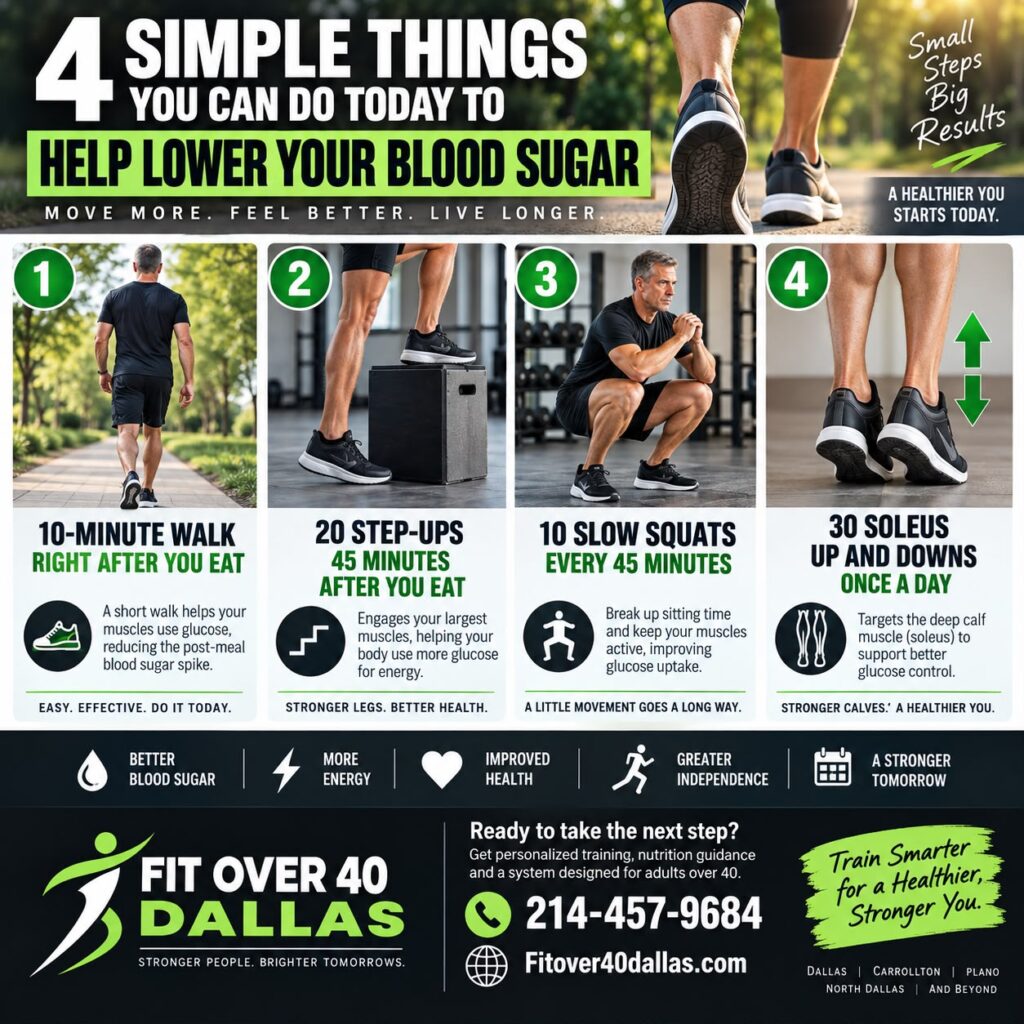
4 Simple Things You Can Do Today to Help Lower Blood Sugar After 40
If you want to lower blood sugar after 40, you may think the solution requires long workouts or dramatic changes to your lifestyle — especially if you’re also concerned about your energy levels, weight or long-term health.
It doesn’t always have to.
One of the most powerful things you can do is also one of the simplest:
Get your muscles working more often — especially after you eat.
Your muscles aren’t just there to make you stronger, help you look better or allow you to lift heavier weights. Muscle is metabolically active tissue, and muscle contractions can help your body use glucose.
That means small amounts of strategically timed movement throughout your day can be valuable.
You don’t necessarily need another 60-minute workout. You may simply need to move more often.
Here are four simple things you can start doing today. Each one takes just a few minutes, and together they form a simple routine to help lower blood sugar after 40.
Why It Gets Harder to Lower Blood Sugar After 40
Blood glucose — commonly called blood sugar — is one of your body’s primary sources of energy.
When you eat carbohydrates, your digestive system breaks them down into glucose. That glucose enters your bloodstream, and insulin helps move glucose from your blood into your cells, where it can be used for energy or stored for later.
This is why movement is such a practical tool if you’re trying to lower blood sugar after 40 — contracting muscles increase their use of glucose. It’s one reason movement after eating can be so useful.
And here’s something I want adults over 40 to understand: exercise doesn’t only count when you’re in the gym.
- A 10-minute walk counts.
- Ten squats count.
- Taking the stairs counts.
- Getting out of your chair and moving counts.
Small bouts of activity accumulated throughout the day can become part of a larger strategy for better metabolic health, strength, mobility and longevity.
Here are four ways to put that idea into practice.
1. Take a 10-Minute Walk Right After You Eat
Start with the easiest strategy. After you finish eating, walk for approximately 10 minutes.
You don’t need workout clothes. You don’t need a treadmill. And you don’t need to walk fast.
Simply get up and move.
Why? Instead of remaining completely sedentary while your blood glucose is rising after your meal, you’re asking the muscles in your legs to start working. Those muscles need energy. One of the fuels available to them is glucose.
Walking after eating has been studied as a practical strategy for improving post-meal glucose responses, and even relatively short bouts of walking can be useful.
The important part is consistency.
- If you’re at work, walk around the building.
- If you’re home, walk around the neighborhood.
- If the weather is bad, walk indoors.
- If you’re at a restaurant, walk around the shopping center before getting back into your car.
Don’t overcomplicate it.
Eat. Then move.
It’s the single easiest habit on this list, and for most people it’s the best place to start if you want to lower blood sugar after 40. That’s a habit almost anyone can understand.
Make the Walk Part of the Meal
Instead of thinking, “I need to exercise after dinner,” change the way you think about it:
The walk is the final 10 minutes of dinner.
That small mindset shift can make the behavior much easier to maintain.
2. Perform 20 Step-Ups About 45 Minutes After Eating
Here’s another simple strategy.
Approximately 45 minutes after eating, find a safe step, staircase or low exercise box and perform 20 controlled step-ups. Alternate legs as you go.
Why step-ups? Because you’re recruiting some of the largest muscles in your body:
- Your quadriceps
- Your hamstrings
- Your glutes
- Your calves
The objective isn’t to turn 20 step-ups into an exhausting workout. We’re simply creating another period of muscular activity.
Twenty repetitions may take only a minute or two. That’s the point.
You don’t always need more time. You need to make better use of the time you have.
Safety Comes First
Choose an appropriate step height. If you have difficulty with your balance, knees, hips or back, hold onto a sturdy railing or support.
If step-ups aren’t appropriate for you, substitute another comfortable lower-body movement.
Remember: the goal isn’t exhaustion. The goal is muscle activation.
3. Perform 10 Slow Bodyweight Squats Every 45 Minutes
This might be one of my favorite strategies for adults who sit most of the day.
Set a timer for approximately every 45 minutes. When it goes off, stand up and perform 10 slow, controlled bodyweight squats.
That’s it. Then go back to your day.
Why? Because one of the problems with modern lifestyles is prolonged sitting. You can work out in the morning and still spend most of your remaining waking hours relatively inactive.
Think about the typical day. You drive to work. Sit behind a desk. Sit during lunch. Drive home. Eat dinner. Then sit on the couch.
One workout doesn’t necessarily eliminate all of that inactivity.
So break it up. Breaking up long stretches of sitting matters just as much as your workout when the goal is to lower blood sugar after 40. Every 45 minutes, stand up and activate your legs.
Quality Over Quantity
These don’t need to be fast squats. In fact, I’d rather see you perform 10 excellent repetitions than 30 sloppy ones.
- Sit your hips back.
- Keep your feet planted.
- Maintain good posture.
- Control the movement down.
- Stand back up.
If regular bodyweight squats aren’t comfortable, use a chair. Sit down under control and stand back up. You’re still using your legs.
And that’s what we’re trying to accomplish — movement snacks throughout the day.
4. Perform 30 Soleus Raises Once a Day
Here’s one you may not have heard about.
The soleus is a deep calf muscle located underneath the gastrocnemius — the larger calf muscle most people see. The soleus works extensively during standing and walking, and researchers have investigated sustained soleus activation and its effects on glucose and fat metabolism.
One easy way to start incorporating more calf activity into your day is with controlled heel raises. Try 30 slow repetitions once per day. You can perform them seated or standing depending on the variation you’re using and your physical abilities.
For a simple seated version:
- Sit upright.
- Keep the front of your feet on the floor.
- Slowly raise your heels.
- Contract the calf.
- Then slowly lower your heels.
- Repeat.
Don’t bounce. Don’t rush. Make the muscles work.
An important distinction: research into the so-called soleus pushup has used a specific sustained movement protocol. Thirty conventional heel raises shouldn’t be presented as identical to that research protocol.
However, the broader lesson remains useful: your calf muscles are muscles too — and finding opportunities to activate your lower body throughout the day can contribute to an overall active lifestyle.
The Bigger Picture: Your Muscles Are a Metabolic Tool
Most people think about muscle in terms of appearance. Bigger arms. Stronger legs. A better chest. A leaner waist.
But after 40, I want you to start thinking differently.
Muscle is part of your longevity strategy.
Your muscles help you stand. Walk. Climb stairs. Play golf. Carry groceries. Get off the floor. Maintain your independence.
And muscle tissue also plays an important role in metabolic health and glucose utilization. Protecting that muscle is a long-term way to lower blood sugar after 40 — and to stay capable as you age.
That’s why maintaining muscle becomes increasingly important as we age.
You Don’t Need Another Hour. You Need the Right System.
One of the biggest objections I hear from busy adults is: “I don’t have time to work out.”
I understand. Many of my clients are busy professionals with careers, families, travel schedules and responsibilities.
But what if we changed the question?
Instead of asking, “Where am I going to find another hour?” ask, “Where can I find 10 minutes?”
- Ten minutes after breakfast
- Ten minutes after lunch
- Ten squats between meetings
- A minute of step-ups
- A few minutes of mobility
These small opportunities add up. You don’t need a new hour in your schedule to lower blood sugar after 40. You need a system you’ll actually repeat.
This is why I believe so strongly in shorter, focused workouts and movement throughout the day. Quality matters more than quantity — and consistency is the key.
Try This Routine to Help Lower Blood Sugar After 40
Here’s your challenge:
- After eating: Take a 10-minute walk.
- Approximately 45 minutes later: Perform 20 controlled step-ups.
- During prolonged sitting: Stand up approximately every 45 minutes and perform 10 slow bodyweight squats.
- Once per day: Perform 30 slow, controlled soleus raises.
Don’t worry about being perfect. Start with what you can do safely and consistently.
You may begin with only the 10-minute walk. Once that becomes automatic, add another strategy.
The goal isn’t to create another complicated fitness program. The goal is to build a healthier lifestyle you can maintain.
Fitness After 40 Should Prepare You for the Next 40 Years
At Fit Over 40 Dallas, I’m not interested in seeing how badly I can beat someone up during a workout. I’m interested in something much bigger:
What do you want your body to be capable of 10, 20 or 30 years from now?
- Do you want to continue playing golf?
- Travel?
- Keep up with your kids or grandkids?
- Get up and down from the floor?
- Maintain your strength?
- Stay independent?
- Feel confident in your body?
Those things don’t happen accidentally. You prepare for them.
And preparation doesn’t require living in a gym. It requires the right system, performed consistently.
Ready to Build a Stronger Body After 40?
If you’re over 40 and want to lower blood sugar, improve your strength, mobility, balance and overall conditioning without spending hours in the gym, I can help.
At Fit Over 40 Dallas, we specialize in efficient, private training for adults 40+. Our workouts are built around one idea:
Train smarter today so your body can continue doing the things you love for decades to come.
Schedule your Fit Over 40 Dallas assessment today and let’s find out where you are, where you want to go, and the right system to help you get there.