
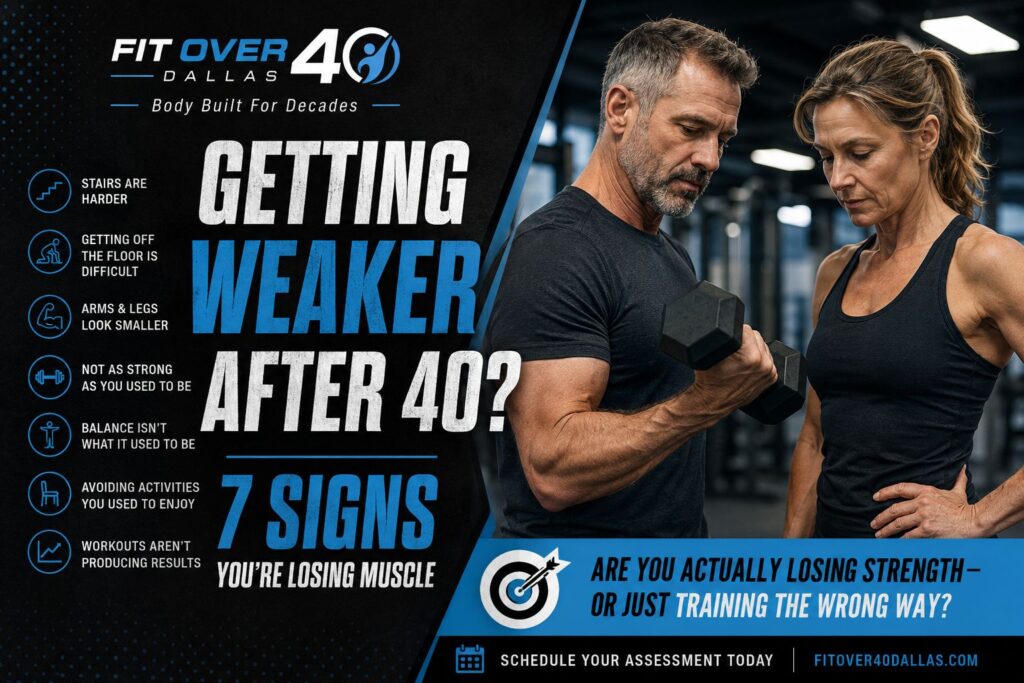
Why Am I Getting Weaker After 40? 7 Signs You’re Losing Muscle
Muscle loss rarely announces itself. Instead, maybe you first notice it walking up a flight of stairs.
Your legs feel heavier than they used to.
Or you get down on the floor and realize getting back up takes more effort.
Maybe carrying groceries feels different. Your arms don’t look as muscular. Your legs seem smaller. You don’t feel as strong in the gym—or you simply don’t have the same energy and physical confidence you had 10 or 15 years ago.
If you’re over 40 and thinking:
“Why am I getting weaker?”
You’re not imagining it.
Muscle loss is real, and muscle mass and strength can gradually decline as we get older, particularly when we’re not doing enough to maintain them.
But here’s the important part:
Getting older doesn’t mean you have to accept getting weaker.
At Fit Over 40 Dallas, we work with men and women over 40 who want to maintain their strength, improve how they move, and continue doing the things they enjoy for decades.
And one of the most important things you can do after 40 is maintain—and when possible, build—your muscle.
Here are seven signs that you may be losing muscle and strength.
1. Stairs Are Getting Harder
One of the first places people notice declining strength is in everyday activities.
Stairs are a perfect example.
Walking up a flight of stairs requires your quadriceps, hamstrings, glutes, calves and core to work together to repeatedly lift your bodyweight.
When those muscles aren’t as strong as they once were, stairs can start feeling surprisingly difficult.
You might notice:
- Your legs burning sooner.
- You need the handrail more often.
- You become winded faster.
- Your legs feel heavy.
- You avoid taking the stairs when an elevator is available.
Many people assume this is simply what happens when you get older.
But declining leg strength can also be a sign that your body isn’t getting enough of the right type of physical stimulus.
The body adapts to what you ask it to do.
If you spend most of your day sitting and rarely challenge the muscles of your legs, your body has little reason to maintain unnecessary muscle tissue.
That’s one reason strength training over 40 becomes increasingly important.
Your workouts should give your muscles a reason to stay strong.
2. Getting Off the Floor Is More Difficult
Here’s a simple question:
Can you comfortably get down on the floor and stand back up?
For many people over 40, the answer gradually changes.
At 30, you probably didn’t think about it.
At 45, 50 or 60, you may suddenly realize you’re pushing off your knee, grabbing a piece of furniture or using your hands to help yourself stand.
Getting off the floor requires more than leg strength.
It also requires:
- Hip mobility
- Core stability
- Balance
- Coordination
- Lower-body strength
This is why I don’t believe fitness after 40 should be based entirely on how much weight you can lift.
Fitness should improve your ability to function.
Being able to confidently get down on the floor and stand back up matters.
Playing with your children or grandchildren matters.
Working around the house matters.
Traveling matters.
Playing golf matters.
Remaining physically independent matters.
The purpose of training after 40 isn’t simply to build bigger muscles.
It’s to build a body that continues working for you.
3. Your Arms and Legs Look Smaller
Sometimes muscle loss becomes visible before people recognize the loss of strength.
You may look in the mirror and notice that your arms aren’t as muscular as they once were.
Your shoulders may appear smaller.
Your legs may look thinner.
Your clothes might even fit differently.
At the same time, your waistline may be increasing.
This combination can happen gradually.
You lose some muscle while gaining body fat, and your overall bodyweight may not change dramatically.
The scale can therefore be misleading.
Imagine losing five pounds of muscle while gaining five pounds of fat.
Your bodyweight hasn’t changed.
But your body composition has.
That’s why we shouldn’t judge fitness after 40 exclusively by bodyweight.
Two people can weigh exactly the same amount while having completely different levels of muscle, strength and physical function.
Maintaining lean muscle becomes increasingly important as we age.
And resistance training is one of the most effective tools we have for doing that.
4. You’re Not As Strong As You Used to Be
Another obvious sign is declining strength.
Maybe weights that used to feel easy now feel heavy.
Perhaps you’ve stopped strength training completely.
Or everyday tasks that you never thought about are becoming harder.
You may notice difficulty:
- Carrying groceries.
- Lifting luggage.
- Moving furniture.
- Carrying something upstairs.
- Picking up your children or grandchildren.
- Doing yard work.
- Opening heavy doors.
- Getting out of a low chair.
These are practical demonstrations of strength.
And this is where people sometimes make a mistake.
They decide they’re getting older, so they should stop lifting weights.
In many cases, that is exactly the opposite of what their body needs.
You don’t necessarily need extreme workouts.
You don’t need to train like a 25-year-old.
You don’t need two-hour gym sessions.
But you do need resistance.
Your muscles need to be challenged if you want them to remain strong.
The goal is appropriate progressive strength training based on your current ability, mobility, injury history and goals.
5. Your Balance Isn’t What It Used to Be
Muscle loss doesn’t only affect how much weight you can lift.
It can also affect your stability.
You may notice that standing on one leg has become more difficult.
Stepping off a curb may feel less automatic.
You may feel slightly less confident walking on uneven ground.
You might catch yourself reaching for something when putting on your shoes or pants.
Strength, balance and stability work together.
Your feet, ankles, legs, hips and core constantly make small adjustments to keep your body controlled.
If those muscles become weaker and you aren’t training balance, your physical confidence can decline.
That’s why balance should become more important, not less important, as we age.
At Fit Over 40 Dallas, strength is only part of the equation.
We want people to develop bodies that are strong and capable.
That means training strength, mobility, core stability, balance and cardiovascular fitness.
6. You’re Avoiding Activities You Used to Enjoy
This sign often sneaks up on people.
You don’t necessarily wake up one morning and decide you’re getting older.
Instead, your world gradually becomes smaller.
You stop playing basketball.
You don’t walk the golf course anymore.
You avoid getting on the floor.
You take the elevator instead of the stairs.
You stop doing certain projects around the house.
You avoid activities because you’re worried your back or knees might bother you.
Eventually, you’re doing significantly less than you were five or ten years ago.
This can create a cycle:
You lose strength → activity becomes harder → you become less active → you lose more strength.
The solution isn’t to suddenly throw yourself into an extreme exercise program.
It’s to start rebuilding your physical capacity progressively.
The right program meets you where you are today and gradually moves you forward.
This is especially important for adults who haven’t exercised consistently in years or who have previous injuries or joint issues.
Fitness after 40 shouldn’t be about punishment.
It should be about preparation.
You’re preparing your body for the next decade of your life.
And then the decade after that.
7. Your Workouts Aren’t Producing Results Anymore
There’s another possibility.
Maybe you’re already exercising.
You’re going to the gym.
You’re walking.
You’re taking classes.
You’re doing exercises you found online.
But you’re still getting weaker.
This is when you need to ask:
Am I actually losing strength—or am I simply training the wrong way?
Doing exercise and following an effective training program aren’t always the same thing.
A productive strength program should have a purpose.
Exercises should be selected based on your needs.
Resistance should be appropriate.
Technique should be controlled.
The program should progress over time.
And your training should account for your mobility, balance, recovery ability, previous injuries and goals.
Simply repeating the same workout with the same resistance month after month may eventually stop producing results.
Your body adapts.
That’s why progressive resistance training matters.
As your body becomes stronger, the challenge should gradually change.
That doesn’t mean constantly adding huge amounts of weight.
Progress can include:
- Better technique.
- Improved range of motion.
- More control.
- Increased resistance.
- Better stability.
- Improved balance.
- More repetitions.
- Greater exercise complexity when appropriate.
The goal is consistent, intelligent progression.
Why Muscle Matters More After 40
Muscle isn’t just about appearance.
Think of muscle as part of your physical retirement account.
You’re building and maintaining something today that you want available later.
Strength helps you climb stairs.
Strength helps you get off the floor.
Strength helps you carry groceries.
Strength supports recreational activities.
Strength helps you travel.
Strength helps you continue doing things for yourself.
This is why building muscle after 40 isn’t simply a bodybuilding goal.
It’s a longevity goal.
The question isn’t only:
“How strong am I today?”
A better question might be:
“What do I want my body to be capable of 10, 20 or 30 years from now?”
Your training today should help prepare you for that future.
Can You Build Muscle After 40?
Yes.
Being over 40 doesn’t eliminate your body’s ability to respond to resistance training.
But the way you train becomes increasingly important.
Your program should take into account:
Your current fitness level
Someone returning to exercise after 15 years shouldn’t necessarily follow the same program as someone who has consistently trained for decades.
Your injury history
Previous back, shoulder, hip or knee problems may require exercise modifications.
Your mobility
If you don’t have the mobility to safely perform a movement, forcing the movement isn’t the answer.
Your recovery
More isn’t automatically better.
Training needs to provide enough stimulus to create adaptation while allowing adequate recovery.
Your goals
A 52-year-old executive who wants more energy and strength may need a different program from a 65-year-old who wants better balance and confidence.
That’s the benefit of individualized personal training for adults over 40.
The program should fit the person.
The person shouldn’t have to fit the program.
You Don’t Need to Spend Hours in the Gym
One of the biggest objections I hear from busy adults is:
“I don’t have time.”
That’s understandable.
Careers, businesses, children, grandchildren and responsibilities don’t disappear because you turned 40.
That’s why our approach at Fit Over 40 Dallas is built around focused 30-minute private workouts.
A productive workout doesn’t have to consume your entire day.
It needs to be structured correctly.
Our goal is to help clients improve strength, mobility, core stability, balance and overall fitness without turning the gym into their second job.
Consistency beats occasional extreme workouts.
Thirty focused minutes performed consistently can be far more valuable than an exhausting workout you dread doing and eventually quit.
Strength Training Over 40 Should Look Different
One of the reasons people stop exercising is because they believe the only options are doing nothing or training like they’re 25.
There’s a better approach.
You don’t have to do endless burpees.
You don’t need to jump onto boxes.
You don’t need workouts designed to leave you lying on the floor exhausted.
And you don’t need to prove anything to anyone in the gym.
You need the right system for your body and your goals.
For adults over 40, I believe training should emphasize:
- Progressive strength.
- Mobility.
- Core stability.
- Balance.
- Cardiovascular health.
- Proper technique.
- Consistency.
- Recovery.
Your workouts should help you leave the gym better prepared for life—not beaten up by your workout.
What Happens If You Ignore Strength Loss?
Strength loss usually doesn’t happen overnight.
That’s what makes it easy to ignore.
A little less muscle this year.
A little less activity next year.
Stairs become harder.
Balance decreases.
You gain some body fat.
Your back feels tighter.
Eventually, activities you once considered normal become challenging.
The best time to address this isn’t when you can no longer do those things.
It’s while you still can.
Think about the difference between training because you have to regain something you’ve lost and training because you want to protect what you still have.
Prevention is powerful.
Personal Training for Men and Women Over 40 in Dallas
At Fit Over 40 Dallas, we specialize in working with men and women over 40 who want to become stronger, move better and maintain their physical independence.
Our private training environment isn’t designed around the latest fitness fad.
It’s designed around the individual.
We work with clients throughout Dallas, North Dallas, Carrollton and Plano who want an efficient, structured approach to fitness.
You don’t have to already be in shape.
You don’t have to know what exercises to do.
And you don’t need to spend hours every week in a crowded gym.
You need to know where you’re starting, what may be limiting you and what type of training is appropriate for you.
That’s where an assessment becomes valuable.
Are You Actually Losing Strength—or Just Training the Wrong Way?
If you’ve noticed that stairs are getting harder, your arms or legs look smaller, getting off the floor isn’t as easy, or everyday activities require more effort than they used to, don’t simply assume:
“I’m getting old.”
Find out what’s actually happening.
You may need more strength.
You may need better mobility.
You may need improved balance.
You may need greater core stability.
Or you may already be exercising but following a program that isn’t appropriate for your body.
Are you actually losing strength—or just training the wrong way? Let’s find out.
Schedule an assessment with Fit Over 40 Dallas and we’ll identify where you are today and what you should focus on to become stronger, move better and keep doing the things you enjoy.
Because the goal isn’t simply to exercise after 40.
The goal is to build a body that performs for decades.