
Body Hurt After 40? 7 Surprising Reasons You Feel Stiff and Sore
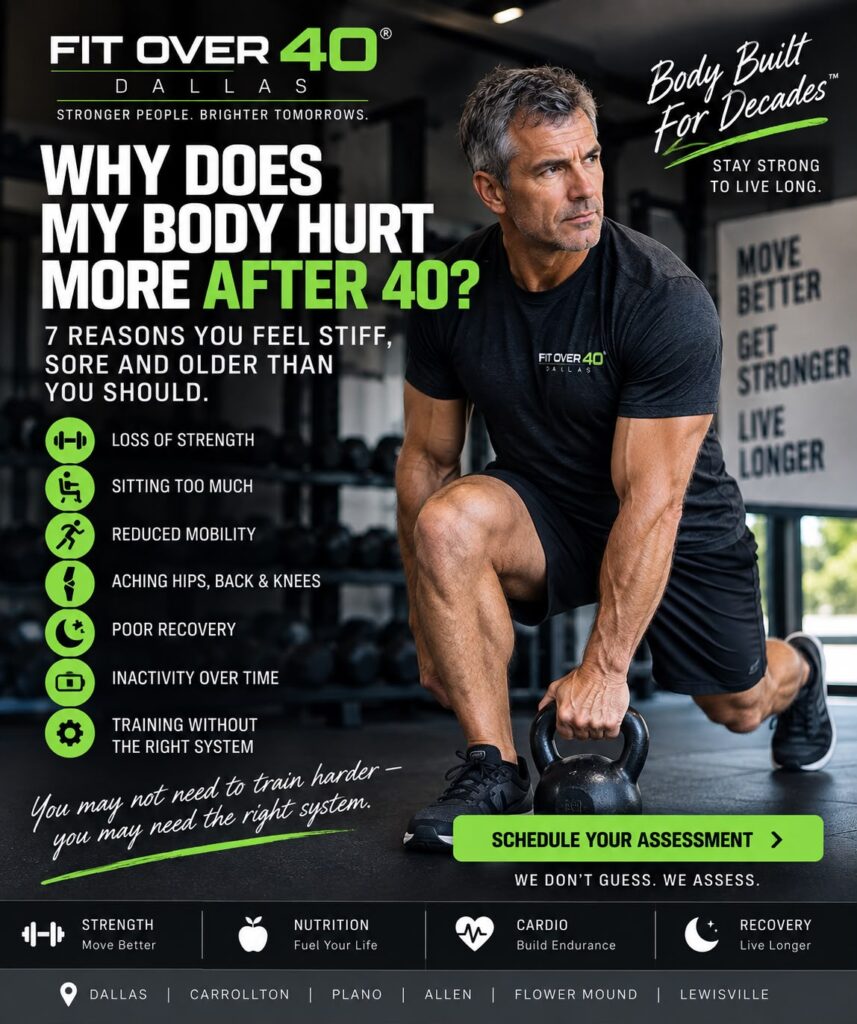
Body Hurt After 40? 7 Surprising Reasons You Feel Stiff and Sore
Why does my body hurt after 40? It’s one of the most common questions I hear, and it usually begins with something small — a stiff back in the morning, or hips that don’t want to cooperate after an hour in a chair.
Your knees bother you going up or down the stairs.
Maybe you bend over to pick something up, and suddenly you realize you don’t move the way you did 10 or 20 years ago.
And if you’re a golfer, you probably notice it even more.
After you get out of the car at the golf course, you need a few minutes just to loosen up. Your backswing feels shorter. Because your hips don’t rotate like they used to, eighteen holes leave your back, knees or hips aching.
Eventually, many people start saying the same thing:
“I guess I’m just getting old.”
But turning 40, 50 or 60 doesn’t automatically mean you’re supposed to hurt every day.
Of course, age changes the body. However, many of the things we blame entirely on aging can also be influenced by how much we move, how strong we are, how well we recover, and what we’ve done with our bodies over the previous several decades.
So here’s the good news: many of those factors can be improved.
In other words, you may not need to train harder. Instead, you may need the right system.
So Why Does My Body Hurt After 40?
Below are seven reasons your body may feel stiffer, sorer and older after 40 — and what you can start doing about each one.
1. You’re Losing Strength
Strength loss is one of the most overlooked reasons a body hurts after 40. Most people assume the problem is flexibility, but in fact it’s usually strength.
As a result, activities that once required very little effort begin requiring more: getting out of a chair, walking up stairs, carrying luggage, picking something up off the floor, working in the yard, getting out of a golf cart, and holding your posture through an entire round of golf.
When you’re strong, everyday activities represent a relatively small percentage of your physical capacity. But as strength declines, those same activities become more demanding.
That’s one reason resistance training becomes increasingly important as we get older.
Also, strength training isn’t just about building bigger muscles or lifting impressive amounts of weight. Rather, it’s about maintaining your physical reserve.
In short, you want enough strength that everyday life doesn’t feel like a workout.
For a golfer, that strength also provides the foundation needed to maintain posture, stability and balance — and eventually to produce speed.
So the goal after 40 shouldn’t simply be to exercise. Instead, it should be to maintain the physical capacity to keep doing the things you love.
2. You Sit Too Much
Many successful adults spend enormous amounts of time sitting. You sit while driving, then at your desk, then in meetings, then while eating. And when you finally come home, you sit again while watching television or scrolling through your phone.
Although the human body is designed to move, it is easy to spend eight, ten or even twelve hours of the day relatively inactive.
After enough time in the same positions, standing up can feel uncomfortable. Your hips may feel tight, your back may feel stiff, your shoulders may round forward, and your upper back may become less mobile.
Then you try to go from sitting all week to playing golf, working in the yard or exercising hard on Saturday. Unfortunately, your body isn’t always prepared for that sudden change in demand.
However, the answer isn’t necessarily stretching for an hour every day.
Instead, start by simply moving more frequently. Take short walks. Stand periodically. Change positions. Move your hips and shoulders. Above all, break long periods of sitting into smaller blocks whenever possible.
Remember: your body gets good at what you repeatedly ask it to do.
So if you spend most of your day sitting, don’t be surprised when your body becomes very good at sitting.
3. You’ve Lost Mobility
Restricted movement is another common reason a body hurts after 40, though mobility and flexibility aren’t exactly the same thing. Flexibility generally describes how much range of motion you have available, while mobility involves your ability to actively control movement through that range.
Of course, you need both.
After 40, common areas where people begin noticing restrictions include:
- Hips
- Ankles
- Thoracic spine, or upper back
- Shoulders
Because these restrictions change how you move, the body starts looking for help elsewhere. If your hips don’t move well, your lower back may attempt to compensate. When your ankles are restricted, your knees may have to work differently as you squat, walk or climb stairs. Similarly, an upper back that doesn’t rotate well forces you to find that rotation somewhere else.
Golfers experience this frequently. Since the golf swing requires rotation through several areas of the body, a golfer whose hips or upper back don’t provide enough movement will try to manufacture that motion elsewhere.
That’s why simply stretching the area that hurts isn’t always the solution. In many cases, the painful area isn’t the original problem.
Therefore, a good program asks a better question: where should you be moving, and where are you compensating?
4. Your Body Isn’t Stable Enough
Mobility gets a lot of attention, but stability is equally important, because your body needs to know how to control the movement it has.
For example, think about your hips. The muscles surrounding them help stabilize your pelvis while you walk, climb stairs, exercise and rotate. However, if those muscles aren’t doing their job effectively, other muscles will try to compensate.
Meanwhile, the same thing happens around the trunk. Your core isn’t simply your abdominal muscles; instead, your trunk transfers force between the upper and lower body while controlling unwanted movement.
In golf, this becomes especially important. A powerful golf swing requires mobility, but it also requires stability. In other words, you need enough mobility to rotate and enough stability to control that rotation.
That’s why endless stretching isn’t always the answer. Sometimes you don’t need more range of motion. Rather, you need better control of the range you already have.
5. You’re Not Recovering Like You Used To
When your body hurts after 40, poor recovery is often part of the picture. At 25, you might have been able to stay up late, train hard, eat poorly and still wake up ready to go. At 45, 55 or 65, though, that strategy becomes much less forgiving.
Training is only one part of improving your body, because recovery matters just as much.
Your recovery can be affected by:
- Sleep
- Nutrition
- Protein intake
- Stress
- Hydration
- Training volume
- Training intensity
- How frequently you exercise
So more exercise isn’t automatically better. Ideally, a workout should challenge your body enough to create an adaptation without repeatedly beating you down.
If every workout leaves you exhausted for several days, then the program may not match your current ability or recovery capacity.
This is especially important for busy professionals. After all, if you’re running a company, working long hours, traveling, raising a family and dealing with normal life stress, your exercise program has to fit into that reality.
In the end, the goal isn’t to prove how hard you can exercise. The goal is to make your body better because you exercise.
6. You’ve Stopped Doing Things That Require Physical Ability
This one happens gradually.
At 30, maybe you played basketball. Then at 35, you stopped. You used to run, until you didn’t. For a while you lifted weights, but then work became busy. And you used to play with your kids, before they grew up.
Slowly, the physical demands placed on your body decreased.
This is where the saying “use it or lose it” becomes important, because your body adapts to the demands you place on it.
If you consistently challenge your muscles, they have a reason to remain strong. When you regularly move through useful ranges of motion, your body has a reason to maintain them. Likewise, if you challenge your balance, coordination and cardiovascular system, those abilities have a reason to remain available.
But if you stop asking your body to do those things, your capacity can gradually decline.
That’s why exercise after 40 shouldn’t only be about burning calories. Instead, you are training your body for your future life — so you can travel, play golf, carry your luggage, get off the floor, walk hills, play with your grandchildren, maintain your independence, and continue doing all of it decades from now.
7. You’re Training Like You’re Still 25 — or You’re Afraid to Train at All
Honestly, I see both extremes. Some people haven’t exercised in years because they’re afraid they’ll hurt themselves. Others, meanwhile, are still trying to exercise exactly the way they did decades ago.
Neither approach is ideal.
Of course, you don’t need to stop challenging yourself because you’re over 40. But your training should have a purpose.
Exercise selection matters. Progression matters. Recovery matters. Technique matters. So does your injury history, and so does your current physical ability.
After all, the person who has spent 25 years behind a desk shouldn’t necessarily begin with the same program as someone who has consistently trained for 25 years.
That’s why I believe in a simple philosophy: we don’t guess, we assess.
Before deciding what exercises you need, determine what your body can currently do. How well do you move? Where are you strong, and where are you weak? What about your balance, your mobility and your ability to stabilize? Then, what happens when you squat, hinge, push, pull or rotate?
For golfers, I also want to understand whether a physical limitation could be affecting the golf swing.
Once you know what your body needs, training becomes much more purposeful.
Does Your Body Hurt After 40? It’s Often Not Just Age
One of the biggest mistakes people make after 40 is assuming every physical change is permanent:
“My knees hurt because I’m old.”
“My back is stiff because I’m old.”
“Because I’m old, I can’t touch my toes.”
“I lost my distance because I’m old.”
“And I’m tired because I’m old.”
Sometimes there are medical or structural issues that need to be evaluated by a physician or physical therapist, particularly when pain is persistent, severe, worsening, associated with an injury, or accompanied by neurological or other concerning symptoms.
But don’t automatically assume your birth certificate explains everything, because your current physical condition matters too.
Strength can be trained. Balance can be challenged. Mobility can often be improved. Cardiovascular fitness can be developed. Movement quality can improve. In other words, your body can become more capable.
In fact, the National Institute on Aging notes that strength training can improve physical function and make everyday activities such as getting out of a chair, climbing stairs and carrying groceries easier.
And that’s the kind of strength that matters.
Train for the Next 20 Years, Not the Next 20 Days
This is where the fitness industry’s obsession with short-term transformations often gets things wrong. Your goal shouldn’t only be, “How much weight can I lose this month?”
Instead, a better question might be, “What do I want my body to still be capable of doing 10, 20 or 30 years from now?”
If you’re 45 today, what do you want 65 to look like? At 55, what do you want 75 to look like? And if you’re 65, what do you want 80 to look like?
Maybe you want to play golf, travel with your spouse, walk through Europe, hike, work in your yard, stay independent, play with your grandchildren — or simply get out of bed in the morning without feeling like everything hurts.
Those aren’t bodybuilding goals. They’re quality-of-life goals. Above all, they require a body capable of supporting the life you want to live.
When Your Body Hurts After 40, You May Not Need to Train Harder
If your body hurts after 40 and you’re constantly stiff, sore or frustrated with what you can no longer do, then doing more random workouts may not solve the problem.
Start by identifying what your body actually needs. Maybe that’s more strength, better hip mobility or improved balance. Or perhaps it’s trunk stability, cardiovascular conditioning, or better recovery because you’re already training too hard. Often, several of those pieces need to work together.
That’s why an assessment should come before the program.
So assess first, train second, and progress from there.
Because the goal isn’t simply to survive another workout. The goal is to build a body that continues working for you for decades.
Stay Strong to Live Long.
Body Built For Decades™
Schedule Your Golf Fitness Assessment
Chris Ownbey’s Golf Fitness — Dallas / Carrollton, Texas
Call: 214-457-9684
90-Minute Golf Fitness Assessment: $150
Stop guessing why you’re losing distance. Get tested, find the weak link, build the body, and increase your potential for speed.
Call 214-457-9684 today to schedule your assessment.