
Is 30 Minutes Enough After 40? Inside Our System 5-20-5™
You want to get stronger, but finding an extra hour in your day can feel unrealistic. Add driving, changing clothes, waiting for equipment, and getting back to work, and a workout can become a much larger commitment than the time spent exercising.
That is why many adults ask me the same question: “Can I accomplish anything in 30 minutes?”
Yes, a well-designed 30-minute session can be a useful part of getting stronger. Whether it is enough for your particular goals depends on the exercises, challenge, weekly schedule, recovery, and activity you do outside the studio.
A short workout is not automatically effective, and a longer one is not automatically better. What matters is whether the available time is used appropriately.
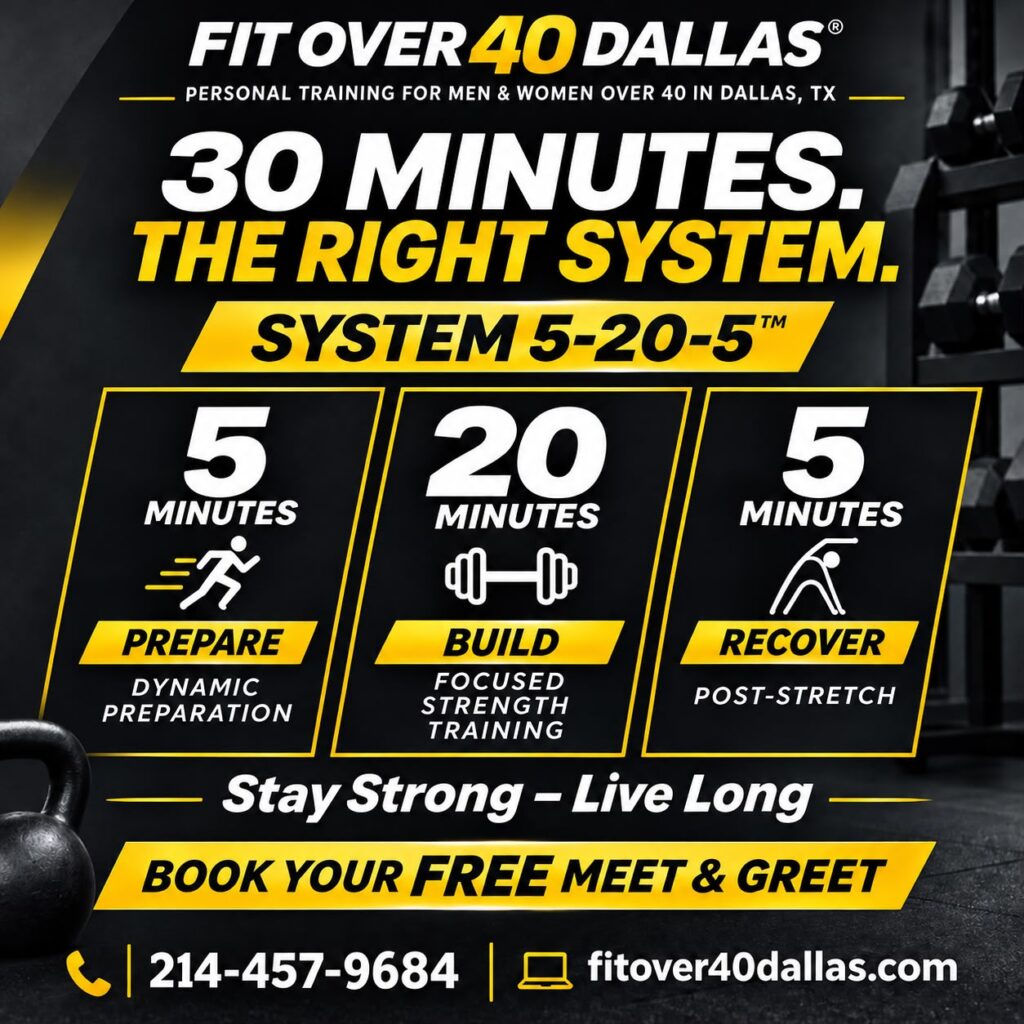
I’m Chris Ownbey, owner of Fit Over 40 Dallas®. Our System 5-20-5™ gives each 30-minute appointment a clear structure: five minutes of dynamic preparation, 20 minutes of focused work, and five minutes of post-stretch. Here is what that means in practice.
First, Define What “Enough” Means
Enough for what? That is the first question worth asking. Someone building a beginner strength routine has different needs from someone preparing for an endurance event or a competitive lifting meet.
If your goal is to establish consistent strength training and improve your performance on suitable exercises, shorter sessions may fit well. If your goals require more total practice or specialized work, you may need additional sessions or a different arrangement.
A useful trainer discusses those tradeoffs openly. Thirty minutes is a session format, not a promise that every possible goal can be accomplished in the same amount of time.
At Fit Over 40 Dallas®, the format serves adults who value focused coaching and manageable appointments. We still have to choose exercises carefully, monitor progress, and adjust the system to the individual.
Why Shorter Appointments Can Be Practical
A workout has to happen before it can help you. If an hour-long appointment repeatedly conflicts with work or family commitments, its theoretical benefits may not translate into a sustainable habit.
A shorter appointment may be easier to place before work, between responsibilities, or during another predictable opening in your day. That practical advantage can matter when you are rebuilding consistency.
However, convenience alone is not enough. A brief appointment still needs a clear purpose and an appropriate exercise dose.
Questions to Ask About Any Short Format
When evaluating a shorter format, ask how the trainer organizes it:
- Is equipment ready?
- Are transitions sensible?
- Is rest allowed?
- Can exercises be adjusted without rushing?
The answers tell you more about the quality of the session than a stopwatch does.
The First 5 Minutes: Prepare With Purpose
Dynamic preparation is the opening part of our System 5-20-5™. Its purpose is to help you transition from your day into the movements you are about to practice.
If you have been sitting for several hours, it makes sense to begin with manageable movement rather than jump straight into your hardest exercise. Preparation can also give your trainer useful information about how you feel today.
Depending on the person, this section might include easy marching, supported movement through a comfortable range, or lighter practice of a planned strength exercise.
There is no single warm-up everyone must perform. Preparation should connect to the main work and respect any restrictions. If you need more time, the session should be adjusted. The structure guides the appointment; it should never force you to hurry into something unsuitable.
The Middle 20 Minutes: Focused Strength Work
The central portion of the session is where we complete the day’s selected exercises. The number of movements and sets depends on your starting point, goals, and need for instruction or recovery.
A beginner may need time to practice fewer movements. A more experienced client may move efficiently through a familiar selection with appropriately planned rest.
For example, a session could include a supported lower-body exercise, an upper-body pull, an upper-body push, and selected trunk work. This is an illustration rather than a universal workout.
The aim is to use the available time deliberately. That includes choosing resistance, coaching technique, observing effort, and making adjustments. A focused session can contain quiet moments of recovery. Constant motion is not the requirement for meaningful work.
Rest Belongs Inside a Productive Workout
One misunderstanding about short workouts is that every second must be filled with movement. That can turn efficiency into unnecessary rushing.
If an exercise leaves you unable to perform the next set with control, you may need more recovery. Your trainer should allow that rather than treating rest as wasted time.
Sometimes alternating exercises that emphasize different areas can make transitions practical. At other times, staying with one exercise and resting between sets is the better choice.
The decision depends on the person and task. It should not be dictated by a desire to keep you breathless. In our studio, the useful question is whether the next set can be performed as intended. Protecting movement quality is part of managing a shorter session well.
The Final 5 Minutes: Post-Stretch and Transition
The closing portion of System 5-20-5™ includes selected post-stretch work and a calmer transition out of the session. It is also an opportunity to discuss how the exercises felt.
The stretches should suit you. You should not be forced into an uncomfortable range, and more intensity is not automatically better.
This part of the appointment is not a promise to prevent soreness, fix an injury, or correct every mobility issue. It is a practical part of the session structure.
Your trainer may also use these minutes to confirm the next appointment or note something to adjust. A brief conversation about an exercise that felt awkward can improve the next session. Finishing with clear feedback helps keep the routine responsive to your experience.
An Illustrative 30-Minute Appointment
A session might begin with a quick check-in and supported preparation from minutes zero through five. During the middle section, the trainer coaches a small selection of appropriate strength exercises and allows recovery as needed.
The final five minutes then include selected stretches and a short review. You leave knowing what you practiced and whether anything changed from the previous visit.
The exact timing can vary. If your first session requires extra instruction, the main work may be smaller. If a symptom needs attention, an exercise may be removed.
That flexibility is essential. The system provides a useful rhythm, but it does not override your needs. A well-coached appointment should never feel like a race to squeeze in exercises simply because they appeared on a list.
Short Sessions Still Need Progressive Challenge
Doing the same easy movements indefinitely is different from following a strength routine that develops with you. The session length does not remove the need to assess progress.
A trainer can track resistance, repetitions, assistance, and technique. Over time, those details help determine whether an exercise should become more challenging.
For example, you might first improve your control at a given weight. Later, you may add repetitions or increase the resistance slightly. The order and pace depend on your response.
The goal is not to set a record at every visit. It is to have a clear reason for maintaining or changing the workload. A short workout should still be part of an understandable longer-term process, with decisions based on what you can do and recover from.
Your Whole Week Matters More Than One Appointment
A 30-minute strength appointment is one part of your weekly activity. It should not be presented as automatically covering every aspect of fitness.
The CDC’s general adult guidance includes aerobic activity as well as muscle-strengthening activity. Two or three studio appointments do not automatically satisfy the aerobic component simply because the sessions feel challenging.
For many clients, walking and other suitable activity have a place outside strength sessions. What you need depends on your current activity, goals, and health considerations.
Discuss your whole week with your trainer. Long periods at a desk, weekend activity, and other exercise all provide context. A useful system makes room for those details instead of pretending the studio appointment exists in isolation.
When a Longer Workout May Make Sense
Some people need or enjoy more time. A person with many specialized goals may require more exercises, practice, or recovery than a 30-minute appointment can reasonably provide.
Another person may prefer a longer session because they enjoy training and have the schedule for it. That preference is valid.
People who need extensive rehabilitation or close clinical supervision may need a different professional setting altogether. A personal training format should not be stretched beyond its appropriate role.
The honest question is whether a session format fits your needs. If it does, shorter appointments can be practical. If it does not, the answer may be a different schedule or service. Good coaching includes recognizing the limits of the format being offered.
What Shorter Workouts Cannot Promise
No appointment length guarantees a particular amount of weight loss or a specific change in body shape. Those outcomes involve more than the minutes spent in a training session.
Be cautious with claims that a brief workout replaces every other form of activity, creates exceptional calorie burning for days, or works equally well for everyone.
A credible explanation should focus on the actual service: coaching, suitable exercise, progressive challenge, and consistent attendance. Those are things a trainer can organize and discuss clearly.
At Fit Over 40 Dallas®, the purpose of the 30-minute format is to make focused training manageable. We still need your feedback, realistic goals, and a schedule you can follow. The system is a structure for doing the work, not a shortcut around it.
How to Judge Whether the Format Works for You
Give yourself several practical questions:
- Can you attend regularly?
- Do you understand the exercises?
- Is the challenge appropriate?
- Are you recovering well enough for everyday life and your next appointment?
Look at your training record too. Are you developing better control, completing more suitable work, or gradually using more resistance when appropriate?
If nothing is changing, discuss it. The solution may involve better consistency, an exercise adjustment, a different training dose, or a review of goals.
If the sessions always feel rushed, that deserves attention as well. A shorter format should simplify the commitment, not make you feel hurried. Your experience and measurable progress provide a more useful evaluation than simply being told that short workouts are effective.
Questions About Our 30-Minute System
Is System 5-20-5™ the same as HIIT?
No. The name describes how the appointment is organized. It does not mean every client performs high-intensity intervals. Exercise selection, effort, and recovery are adjusted to the individual.
Do I have to move quickly?
No. Movements should be performed with the control and pace appropriate to the exercise. Racing between stations is not a requirement. Tell your trainer if the pace makes it difficult to recover or understand instructions.
Is one weekly session enough?
It may be a workable starting commitment for some people, but whether it is sufficient depends on goals and the rest of the week. Your trainer should explain the tradeoffs and discuss any additional independent activity that is appropriate.
Will every appointment use the same exercises?
The structure can remain consistent while exercises change when needed. Some repetition is useful for practice and tracking. Changes should have a purpose rather than being made only to keep every session different.
Make 30 Minutes Count at Fit Over 40 Dallas®
A manageable appointment can make starting feel possible. A clear structure and thoughtful coaching can help that appointment become part of a routine you maintain.
At Fit Over 40 Dallas®, our private, one-on-one sessions use System 5-20-5™ to organize preparation, focused work, and post-stretch within a 30-minute format.
Visit Fit Over 40 Dallas or call or text 214-457-9684 to request your free Meet & Greet. We can discuss your goals, answer your questions, and help you decide whether the format fits your life.
30 Minutes. The Right System.
Stay Strong – Live Long.
Read Other Related:
- Why Men and Women Over 40 Feel Tired All the Time
- Can You Build Muscle After 50?
- Why Am I Getting Weaker After 40? 7 Signs of Muscle Loss
- Body Hurt After 40? 7 Surprising Reasons You Feel Stiff and Sore
- Taking a GLP-1? Protect Your Muscle While Losing Weight
- Why Belly Fat Gets Harder to Lose After 40
- The Truth About Belly Fat After 40
- You Don’t Need a Harder Workout. You Need the Right System.
- THE BRUTAL TRUTH ABOUT RUNNING AFTER 50
- GLP-1 Weight Loss Over 40: Protect Muscle & Strength | Fit Over 40 Dallas
- Personal Fitness Training In Plano Texas
- Why Do Men Lose Muscle After the Age of 40?